Academician Wu Chi from the Food Science and Processing Research Center of Shenzhen University appeared on the CCTV talk show "VOICE": unlocking the "molecular code" of food
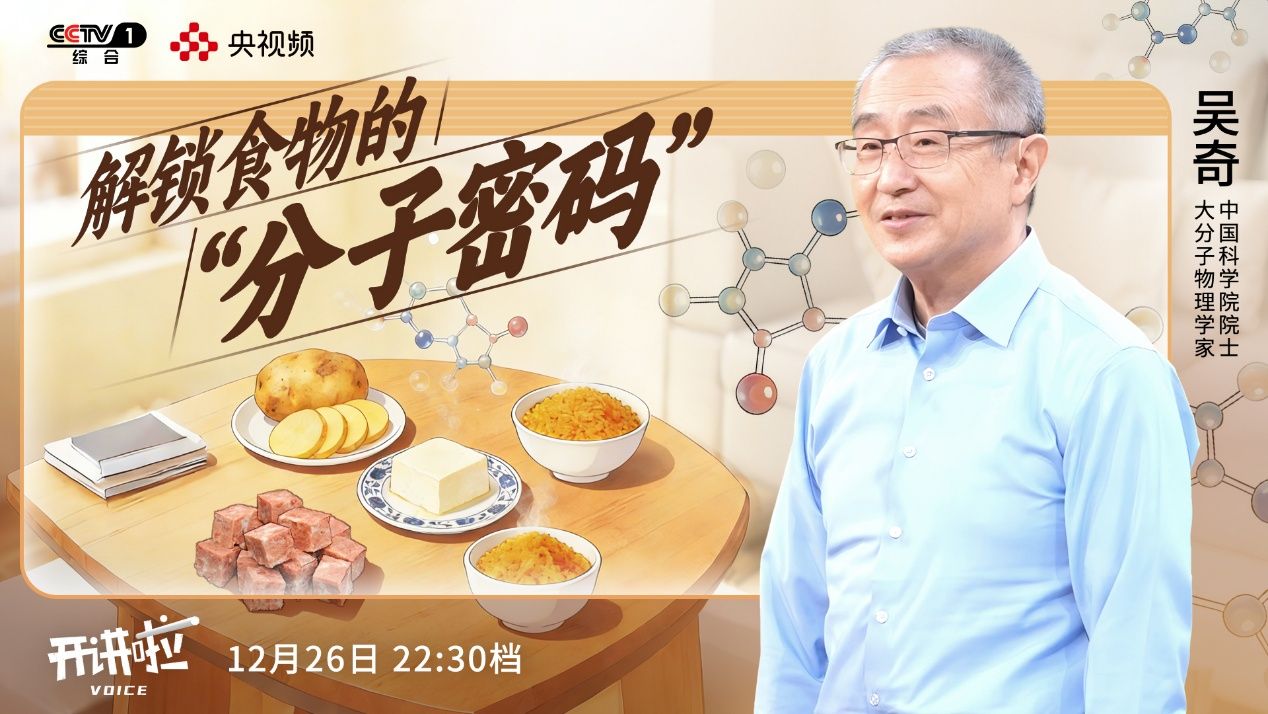
Wu Chi, academician of the Chinese Academy of Sciences and director of the Food Science and Processing Research Center at Shenzhen University was invited to participate in a recording of CCTV's youth television open class program, "VOICE". Accompanied by host Sa Beining, Prof. Wu revealed to us the world of macromolecular physics hidden in ordinary life, especially in kitchen cooking.
In the program, Prof. Wu introduced how the research team at the Food Science and Processing Research Center uses the "macromolecular magic" of science and technology to "transform coarse grains into refined grains, animal feed into human food, and supplementary grains into staple grains, striving to open up new paths for firmly securing our nation's food supply." Specifically, this includes (i) processing soybean meal into vege-meat to address insufficient protein intake among the Chinese population; (ii) processing fresh potatoes directly into "potato rice" to address food security and rural revitalization in impoverished areas; (iii) revolutionizing the traditional process of soy product processing, creating a novel whole-soybean tofu production process that fundamentally solves pollution, reduces costs, and improves the nutritional value of soy products.
In the program, Prof. Wu also mentioned that before the age of sixty he focused on conducting basic research, while in the last decade he has turned his attention to applied research with actual potential for marketability. "At the turn of the millennium, I advocated the metaphor of 'Two Shelves', i.e. research should either contribute to knowledge belonging on book-shelves or actual products belonging on stock-shelves; superficial research that contributes to neither should be avoided. And it's not easy to get on either shelf!"
Prof. Wu's participation in this open lecture was not only a successful demonstration of popular science - by seamlessly linking advanced macromolecular physics theories with everyday food processing and cooking - but also vividly showcased Shenzhen University's innovative strength in food science and processing. Furthermore, it showcased the pragmatic spirit of scientists who integrate their research into people's lives and dedicate themselves to solving practical problems. The program conveyed core scientific thinking in a relaxed and engaging way, effectively stimulating the public's desire - especially young people's interest - to explore science and technology.
In the future, under the leadership of Prof. Wu, the Food Science and Processing Research Center of Shenzhen University will continue to take the "Broad Food Perspective" as its core idea. This idea links China's food supply security to innovative food processing, as opposed to the conventional view of increasing yield per acreage from arable land. Under the conditions of not increasing arable land use area or grain yield, food processing and research & development can optimize the use of existing raw materials.


