The 36th lecture in the "Guo Yonghuai Forum"—Academician Wu Chi's presentation, "What is Basic and Applied Research?"
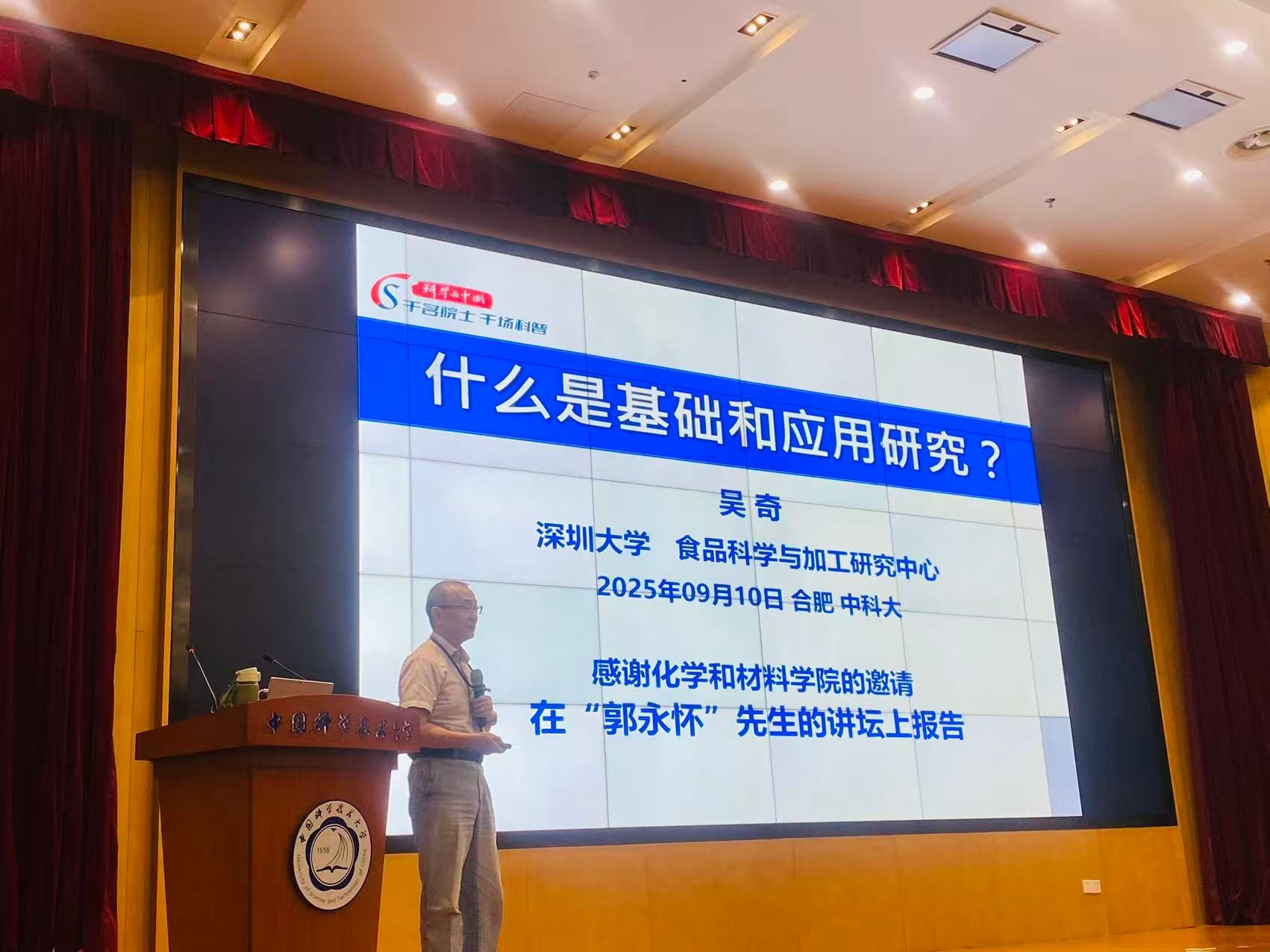
On September 10, 2025, the 41st National Teachers' Day, the School of Chemistry and Materials Science at the University of Science and Technology of China (USTC) hosted an intellectual feast. Academician Wu Chi of the Chinese Academy of Sciences, as the speaker of the 36th lecture in the "Guo Yonghuai Forum," delivered a brilliant special presentation entitled "What is Basic and Applied Research?" to faculty and graduate students. The 300-seat lecture hall in the Materials Research Building was packed, with over 100 faculty and students standing on the sides and in the back aisles to listen to the nearly one-and-a-half-hour presentation and participate in a lively half-hour discussion. The lecture was chaired by Professor Liu Shiyong, Executive Dean of the School of Chemistry and Materials Science.
I. Conceptual Analysis: From "Question" to "Problem"
As a senior researcher in the field of polymer physics and chemistry with over forty years of research experience, Academician Wu analyzed the essential differences between "question," "inquiry," and "problem". By using rigorous academic logic, he deconstructed the core essence of basic and applied research. Naturally, questions arise from curiosity. But many questions are essentially inquiries, not true "problems"; that is, the question already has an answer, but the questioner is unaware of it due to limitations in knowledge or experience. True "problems" are those that have remained unanswered/unsolved throughout history. There are two scenarios for resolving these kinds of questions (problems): First, existing knowledge is insufficient, requiring the discovery of new knowledge - that is, intellectual contributions that push the boundaries of human cognition - which qualify as basic research. Applied research, on the other hand, uses existing knowledge to solve problems. If its results cannot predict other systems or have practical applications, even if it answers questions that predecessors haven't answered, it's not very useful. This distinction is not merely a semantic debate but also concerns the underlying logic of scientific research evaluation.
II. Unity of Knowledge and Action: From Book-shelf to Stock-Shelf
To make abstract concepts more concrete, Academician Wu shared two typical examples from his research career. The first example revolves around the scaling relationship between the concentration difference of the concentrated/dilute phases in a macromolecular solution phase diagram and the reduction temperature and chain length. He kept this problem in mind for twenty years until he encountered an experimental solution, finally successfully revealing a previously unknown law in this field and completing the final piece of the puzzle for macromolecular solution phase diagrams! The academician emphasized that the "knowledge" revealing the essence and laws of objective things must satisfy two ironclad rules - "universality" and "quantitativeness."
The second example also involved a long process of searching for a "problem." The academician had been searching for an increasingly important question, hoping it would be relevant to society and the people, have Chinese characteristics, and that he was one of the best candidates to solve it. Finally, at the end of 2016, he found it in innovative food processing. After retiring from the Chinese University of Hong Kong in 2020, he devoted himself entirely to shifting his work from "synthetic macromolecules" to "natural macromolecules," entering a completely new field of applied research. In this new field, he and his team proposed the concept of "whole food processing". By utilizing knowledge of macromolecular physics and polymer processing, they transformed this concept into technology, achieving fruitful results in three projects: potato rice, vege-meat, and whole-bean tofu.
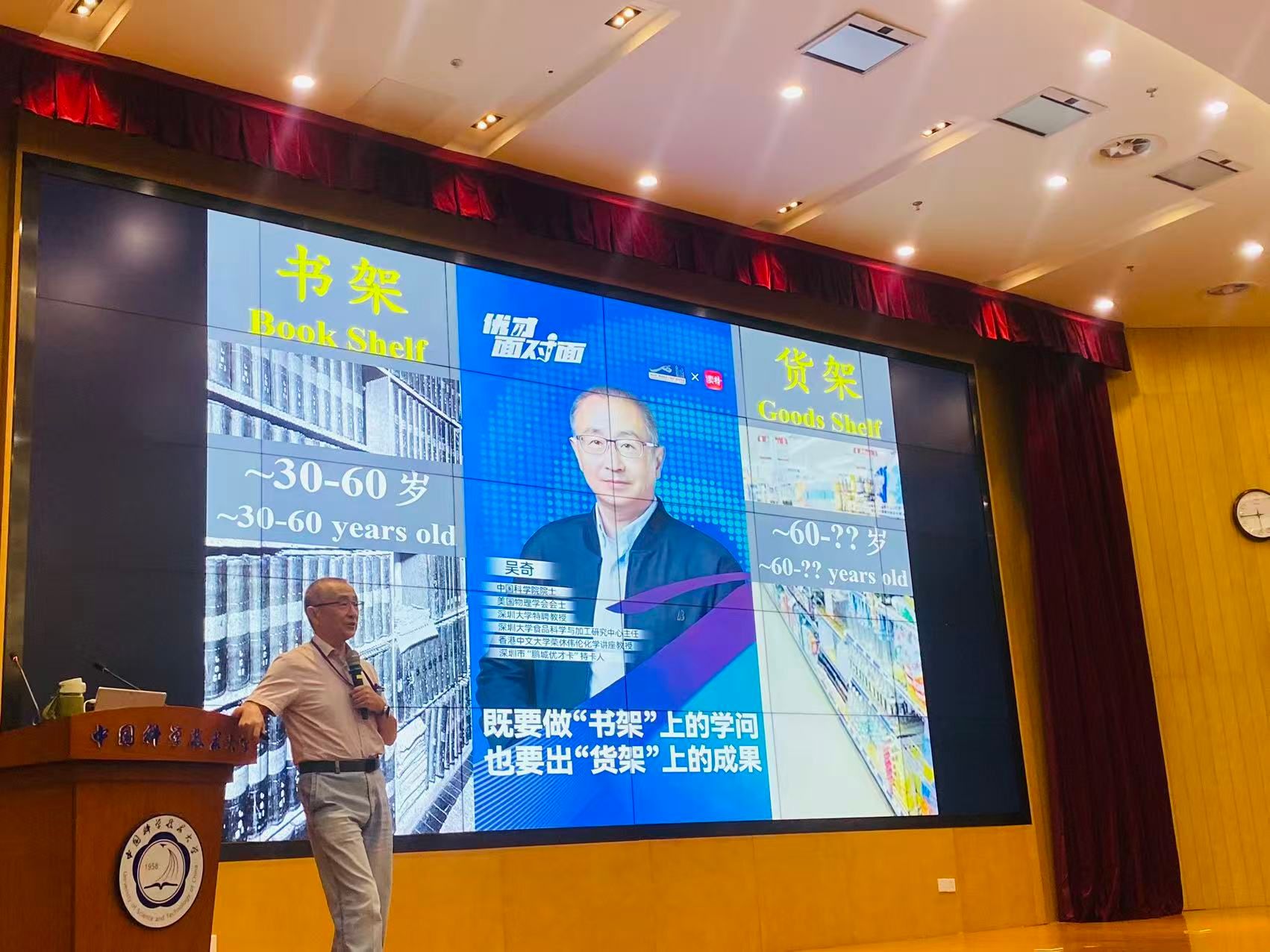
"Not on the book-shelf, but on the stock-shelf"—this metaphor of "Two Shelves" proposed by Academician Wu Qi about twenty-five years ago has now gained widespread acceptance among researchers and become a gold standard for measuring the value of scientific research.
III. Remembering the Spirit: From Scholarship to Character
During the report, the academician repeatedly commemorated the deeds of Guo Yonghuai, a pioneer of China's nuclear weapons program, highly praising Guo's scholarly attitude and dedication. He encouraged the graduate students present: "The results of basic research are often reflected in articles, but the vast majority of articles have nothing to do with basic research. Individuals will eventually disappear; true immortality is merging oneself into something immortal. Guo Yonghuai is immortalized because he merged himself into the nation's self-reliance and strength! Those who contribute knowledge to textbooks are immortalized because they broaden the boundaries of human knowledge." He also commemorated Professor Ma Xingxiao, expressing gratitude for Prof. Ma's advice: "Being a good person and pursuing scholarship are both indispensable, but being a good person comes first, followed by scholarship!"
The report concluded with enthusiastic applause. Professor Xu Yunhe, the Party Secretary of the College, presented Academician Wu with a commemorative plaque for the "Guo Yonghuai Forum" on behalf of the College, and students presented flowers to Academician Wu, wishing him a "Happy Teachers' Day!" This academic event, held on Teachers' Day, was a vivid open class on scientific research methodology. It not only clarified the dialectical relationship between basic and applied research for young scholars, but also interpreted the ultimate meaning of education through the practical actions of scientists, highlighting the spirit of teachers who impart knowledge and teach skills.


